Brahe Church
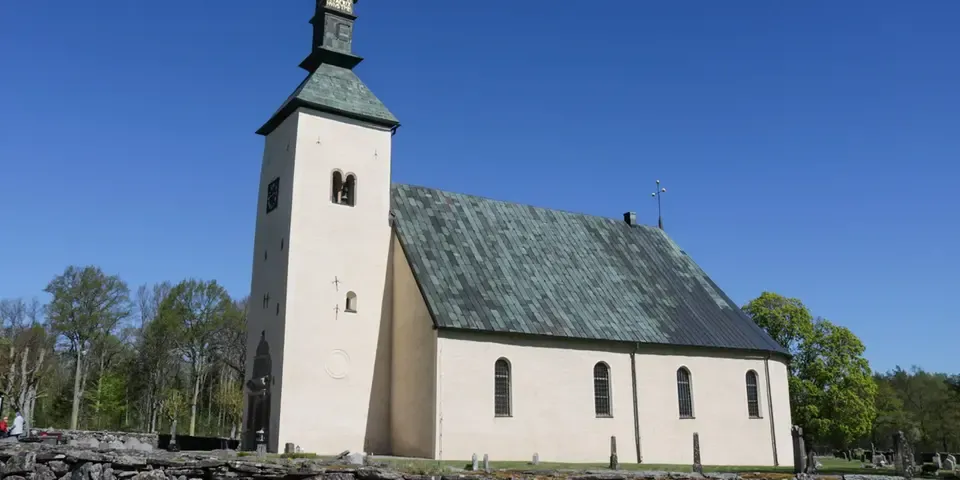
Here you can learn about Brahekyrkan, its history and the Iron Age remains beneath the ground surrounding the church.
Brahe Church was built in the early 17th century as the church of Visingsborg Castle and is closely associated with the power and influence of the Brahe family during Sweden’s Great Power era (c. 1611–1721). The church was built on the site of the medieval Ströja Church from the 12th century, which had previously served as the church of the royal residence of Näs Castle. During the reconstruction, Magnus Brahe had large parts of the older church demolished but retained the tower, which still bears witness to the site’s medieval roots. The church was consecrated in 1636 and was subsequently further developed by Per Brahe the Younger, who gave it a magnificent interior featuring paintings, sculptures and monuments in the grand style that typified the era. Brahe Church became both a religious centre, an expression of aristocratic prestige and a burial church for several members of the Brahe family. Through its architecture, art and function, the church reflects the transition from the royal power of the medieval era to the period of aristocratic power on Visingsö.
An Iron Age house beneath the asphalt
When you drive on the new road today or park by Brahe Church, it is easy to miss what lies hidden beneath the asphalt. There are traces here of a much older landscape. During 1995–1996, archaeologists from Jönköping County Museum carried out investigations in the area. The aim was to find remains of the medieval village of Ströja.
Ströja was one of three villages that Per Brahe the Elder had cleared in the 1570s, when the land was needed for the construction of Visingsborg Castle. It is likely that the village was located nearby, as this was the site of Ströja Church. The tower, dating from the 12th century, still stands and today forms part of Brahe Church. The rest of the church was demolished in the 17th century when Magnus Brahe rebuilt it in Baroque style. There are also indications that the church may have had an even older, wooden predecessor. A decorated stone slab featuring a grey-painted snake, found in the churchyard, was part of an early funerary monument dating from the late 11th or early 12th century. This may suggest that a Viking-era or early medieval manor stood nearby and that the church was built on the manor’s land.
Contrary to expectations, no traces of the village of Ströja itself were found. However, something even older was discovered: an extensive Iron Age settlement. Between the car park and the road leading to the bell tower were roughly eighty hearths, cooking pits and refuse pits. The structures have been dated to the Iron Age, approximately 500 BC to 1050 AD.
Among the finds were many post holes which turned out to belong to a large longhouse, dating back to roughly the same time as the birth of Christ. The house stood with its gable facing the water, right where the ground begins to slope down towards the lake. Given its location and size, the building was likely visible from far and wide, potentially a farmstead of particular significance.
The site serves as a reminder that Visingsö’s history stretches far further back than churches, fortresses and castles – and that traces of Iron Age people still remain, sometimes just a few decimetres beneath our feet.
The Church of Sweden - Gränna-Visingsö Parish
Senast granskad/publicerad:
