Sundial, fountain and sculpture in Brahe Park
Brahe Park was constructed between 1946 and 1948 on the initiative of the engineer and art connoisseur Malte Liewen Stierngranat.
He wanted to make the most of Gränna’s favourable growing climate to plant trees and shrubs that are unusual for these latitudes. Even today, the park stands out for its plane trees, with their flaking bark and its common walnut and two stately ginkgo trees. However, Brahe Park is not just a place for plants – it also features several works of art
The fountain
The fountain in the park was designed by Stierngranat following a visit to the 16th-century garden at Villa d’Este, outside Rome. He later had a replica cast from his design. The fountain is therefore a reproduction of a fountain that was already nearly 700 years old at the time this copy was made. Unfortunately, the original fountain was destroyed during the Second World War.
The sundial
Another work of art in the park is the sundial, which was made from copper by Gösta Fong, a resident of Gränna and metalworker, using the techniques of repoussé and chasing. The sundial stands on a granite base created in 1948 by the sculptor Torwald Alef, who was born in Jönköping. The base is adorned with motifs featuring the town’s founder, Per Brahe the Younger, and the Brahe coat of arms. Both the fountain and the sundial were donated to the town by Malte Liewen Stierngranat.
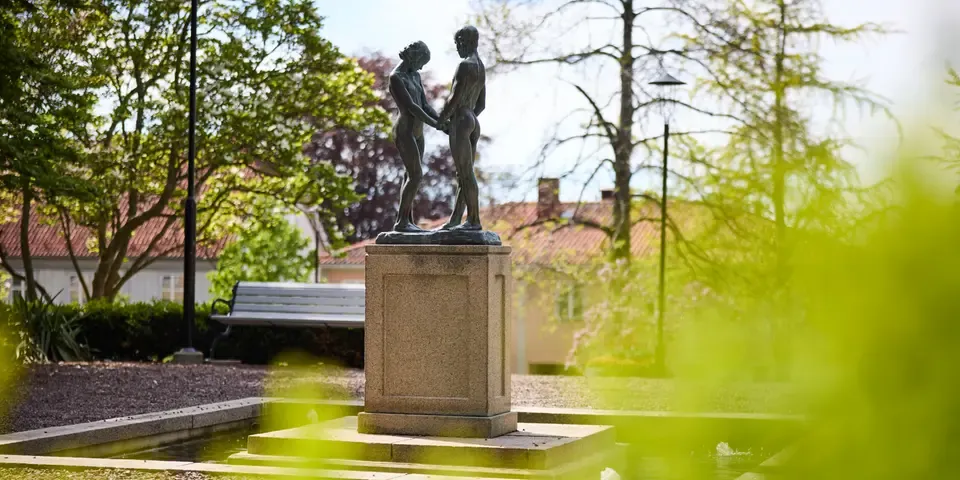
Ungdom (Youth)
On the park’s upper terrace stands a copy of Carl Eldh’s sculpture Ungdom, created in 1912. The sculpture in Brahe Park is a replica that was unveiled in 1948. It depicts two young people tenderly holding hands – a serene and timeless feature of the park environment.
The stone slab in Brahe Park
On the lower terrace of Brahe Park is a stone slab created by the stonemason P. V. Petersson.
The slab dates back to 1947 and is made of granite. It is inscribed with the words Brahe-parken (Brahe Park) and a relief depicting the northern hemisphere, featuring a compass needle.
The stone slab is set into the gravel path and can therefore be easily missed. However, if you take a second look, you will discover a subtle yet thoughtful detail – a small inscription marking the park’s name and its place in the world.
Senast granskad/publicerad:
